















Starbucks Boosts Investments in Focus Market India Despite Mounting Losses !
Prime Vista News
Starbucks is accelerating investment in India through store expansion and menu localisation even as losses at its Tata Starbucks joint venture nearly doubled to $16.5 million in the year to March.
Starbucks Corp. is doubling down on India, expanding its store network and sharply localising its menu, even as losses at its Indian joint venture continue to widen. The strategy underlines the coffee giant’s long-term confidence in the world’s most populous country, which it considers one of its most important global growth markets.
The Seattle-based company operates in India through Tata Starbucks Pvt. Ltd., an equal joint venture between Starbucks and the Tata Group. Despite rising losses, the business is prioritising scale, brand presence and consumer engagement over near-term profitability.
“We are very clear that India remains a focus area as much, if not more,” Sushant Dash, Chief Executive Officer of Tata Starbucks, said in a recent interview, noting that India now ranks among Starbucks’ top five markets globally. Dash added that while the business has turned cash positive, it is not yet profitable and no specific timeline has been set for turning earnings positive.
Losses Rise Even as Revenue Grows
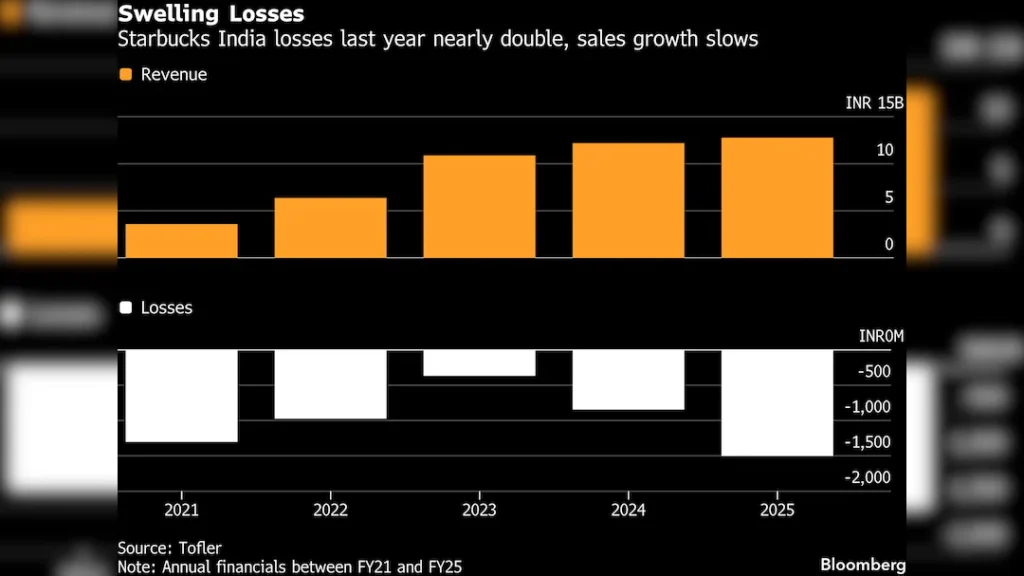
The expansion push comes at a time when financial pressure is increasing. According to data platform Tofler, Tata Starbucks reported losses of ₹1.5 billion ($16.5 million) in the year ended March, nearly double the previous year’s losses. This came despite a 4.8% increase in revenue, highlighting the cost-intensive nature of the company’s aggressive growth strategy.
India remains a highly competitive and price-sensitive market, with Starbucks facing mounting pressure from agile local players. Budget-focused brands like abCoffee and premium specialty chains such as Blue Tokai have gained traction by offering lower prices, local sourcing and strong digital-first engagement.
At the same time, India’s broader consumption environment has softened, with urban discretionary spending under strain adding to the challenge for global brands positioned at the premium end of the market.
Global Headwinds Add to the Pressure
Starbucks’ India push is unfolding against a backdrop of wider global challenges for the company. Internationally, the coffee chain has been grappling with slowing demand, operational restructuring and geopolitical fallout.
Last year, Starbucks sold a 60% stake in its China business, its second-largest market, as it reassessed growth prospects. It has also faced consumer boycotts in parts of the Middle East linked to geopolitical tensions, while in the United States, its largest market, the company is working to revive customer traffic and streamline operations.
Against this uncertain global backdrop, India stands out as a long-term opportunity albeit one that requires patience and sustained investment.
Menu Localisation Takes Centre Stage
A core pillar of Tata Starbucks’ strategy is deep menu localisation, aimed at appealing to Indian tastes while preserving the global Starbucks brand.
Drawing from Starbucks’ international playbook such as offering egg rolls in Singapore during Lunar New Year the India unit has rolled out region-specific offerings across the country. These include Malabar egg roast and keema variants in southern India, a Kosha Mangsho-inspired wrap in Kolkata, and Vada Pav-style buns in Mumbai, alongside globally familiar beverages.
The company has also expanded into protein-packed coffee drinks, low-calorie snacks, bite-sized portions and shareable food options, responding to shifting consumer preferences.
Earlier Coverage : Who Owns Galgotias University? A Closer Look Amid Robotic Dog Controversy
Health Trends and Younger Consumers
Younger Indian consumers are increasingly driving demand for cold brews, refreshers and lighter beverages, including options made with alternative milk, Dash said. Starbucks is also leaning into health and fitness trends, offering zero-sugar drinks and protein-forward food items such as Soya Protein Toastie and Chicken Ragi Flatbread.
The aim, according to the company, is to integrate Starbucks into evolving lifestyle habits, particularly among urban, fitness-conscious customers.
Signs of Stabilisation
Some of Tata Starbucks’ efforts appear to be gaining traction. Same-store sales growth, a key industry metric, stood at 3% for two consecutive quarters, according to Tata Consumer Products Ltd., the Tata Group entity that partners in the venture. This marked a turnaround after earlier year-on-year declines.
The chain also added 12 new stores in the most recent period, taking its total footprint to 504 stores across 81 Indian cities, reinforcing its position as the largest coffee chain in India by store count.
A Long-Term Bet
Despite rising losses and intensifying competition, Starbucks is signalling that it is prepared to play the long game in India.
“The company will need to keep doing new things,” Dash said, pointing to continuous innovation as key to staying relevant in a fast-changing market.
For Starbucks, India represents both a challenge and an opportunity a market where profitability may take time, but scale, demographics and long-term consumption trends continue to justify deeper investment.