














Digital Agriculture-Canadian Professor Brings Global Vision to Punjab Agricultural University:
Ludhiana | Prime Vista News
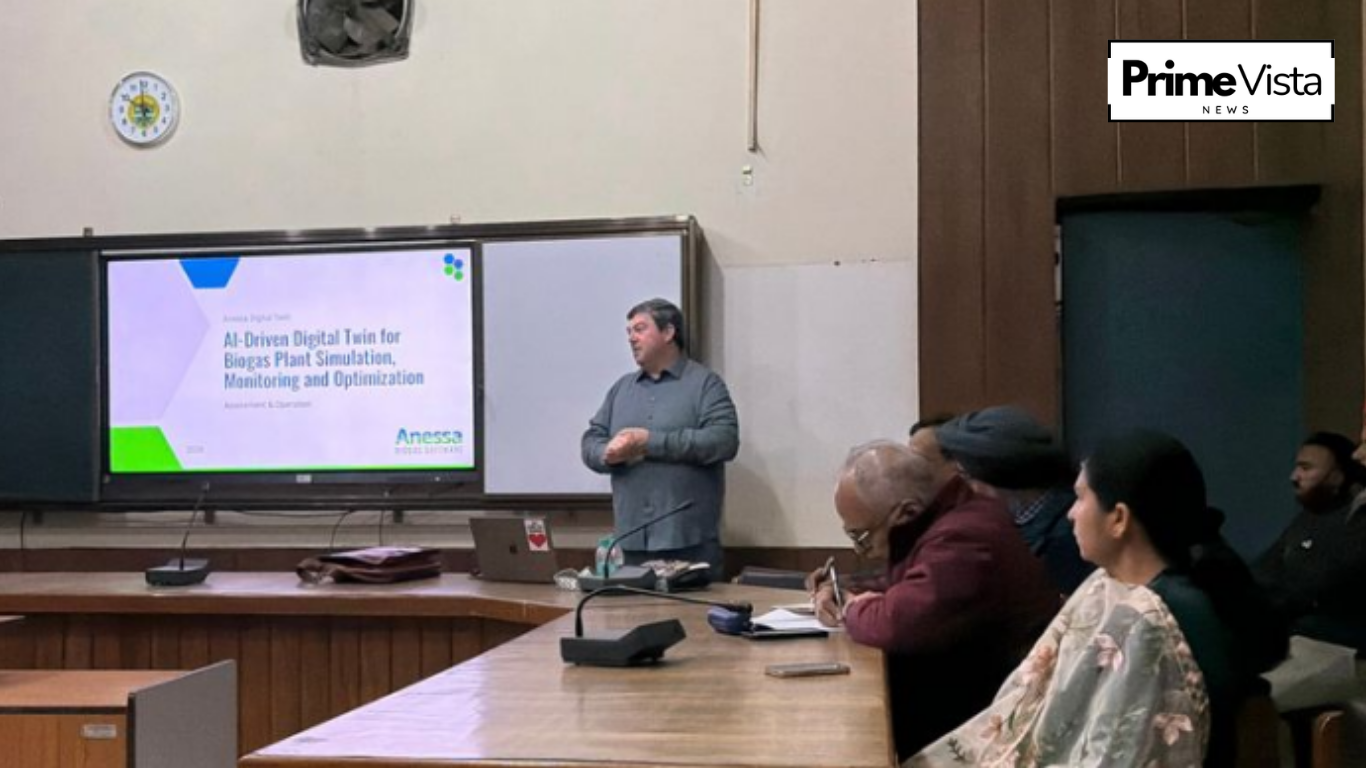
Digital agriculture is rapidly reshaping the future of farming by integrating artificial intelligence, data-driven technologies, and innovative research approaches to address challenges of sustainability, efficiency, and productivity. Bringing this global perspective to Punjab Agricultural University (PAU), Dr Kenneth B Kent, Professor at the University of New Brunswick (UNB), Canada, recently shared insights on how advanced digital tools are transforming agriculture into a smarter and more resilient sector.
Dr Kent, who holds the Barrett Chair in Entrepreneurship for Digital Transformation and serves as Director of the IBM Centre for Advanced Studies–Atlantic at UNB, highlighted the growing role of artificial intelligence in modern agricultural systems. He explained how AI-driven solutions, particularly Digital Twins, can help simulate and optimise real-world processes, ranging from biogas plant operations to precision farming practices.
According to Dr Kent, digital agriculture is no longer a futuristic concept but a practical and scalable approach that can support farmers, researchers, and policymakers today. He emphasised that technologies such as AI-based modelling and data analytics are essential for improving decision-making, reducing resource wastage, and enhancing overall productivity in agriculture.
Global Expertise Meets Local Innovation
Drawing from his extensive experience and international collaborations in Canada and Germany, Dr Kent demonstrated how digital tools are already being applied successfully in diverse agricultural and industrial contexts. He stressed that similar approaches could be adapted to Punjab’s agricultural ecosystem, where innovation is increasingly required to address issues such as climate variability, resource constraints, and economic sustainability.
The sessions were organized by the Alumni Association of the College of Agricultural Engineering and Technology, in collaboration with the Department of Electrical Engineering and Information Technology at PAU. Nearly 50 postgraduate students and faculty members participated, engaging actively with Dr Kent’s ideas and experiences.
Japan’s decision to cancel it’s iconic cherry blossom festival has sparked widespread curiosity.
Encouraging an Innovation Mindset Among Students
Discussions during the sessions covered a wide range of topics, including AI-driven simulations, research publishing strategies, and entrepreneurship in digital agriculture. Speakers and participants alike emphasised the importance of encouraging students to view themselves not just as researchers, but as innovators capable of contributing to agriculture’s digital transformation.
Dr Kent urged students to explore interdisciplinary approaches, combining engineering, data science, and agricultural knowledge to develop practical solutions. He highlighted that innovation in agriculture increasingly depends on collaboration across domains and institutions.
Leadership Emphasises Digital Readiness
Dr Manjeet Singh, Dean of the College of Agricultural Engineering and Technology, underscored the importance of embracing emerging technologies. “Digital innovations are the need of the hour,” he said, encouraging students to align their academic research with modern tools such as AI, data analytics, and simulation models.
He also cited the academic journey of Dr Harpreet Kaur, who recently completed her PhD at UNB under Dr Kent’s supervision, as an example of how international collaboration can help build local expertise and strengthen institutional capacity.
Role of Research and Entrepreneurship
Dr Preetinder Kaur, President of the Alumni Association, highlighted the relevance of technologies like Artificial Intelligence and Digital Twins in modelling complex physical systems. She noted that while technical skills are essential, equal importance must be given to research publishing and entrepreneurship to ensure professional growth and real-world impact.
She encouraged students to look beyond traditional academic pathways and consider innovation-driven ventures that can translate research into practical agricultural solutions.
Preparing for the Future of Farming
The event concluded with the distribution of certificates to participants, but the broader message extended far beyond formal recognition. The interactions reinforced PAU’s commitment to positioning itself at the forefront of digital agriculture, equipping students with the knowledge and mindset required to navigate a rapidly evolving agricultural landscape.
As agriculture increasingly intersects with digital technologies, initiatives such as these signal a shift towards a future where students are prepared not only to cultivate crops, but also to shape the future of farming through innovation, research, and global collaboration.