












Abhishek Sharma Equals Sanju Samson’s Record After Third Consecutive Duck at T20 World Cup 2026 :
Prime Vista News
India opener Abhishek Sharma records his third straight duck at the ICC Men’s T20 World Cup 2026 in Ahmedabad, equaling Sanju Samson’s record for most T20I ducks in a calendar year.
India’s T20 World Cup campaign continued in Ahmedabad on Wednesday with a commanding team performance, but the spotlight briefly fell on opener Abhishek Sharma for an unwanted reason.
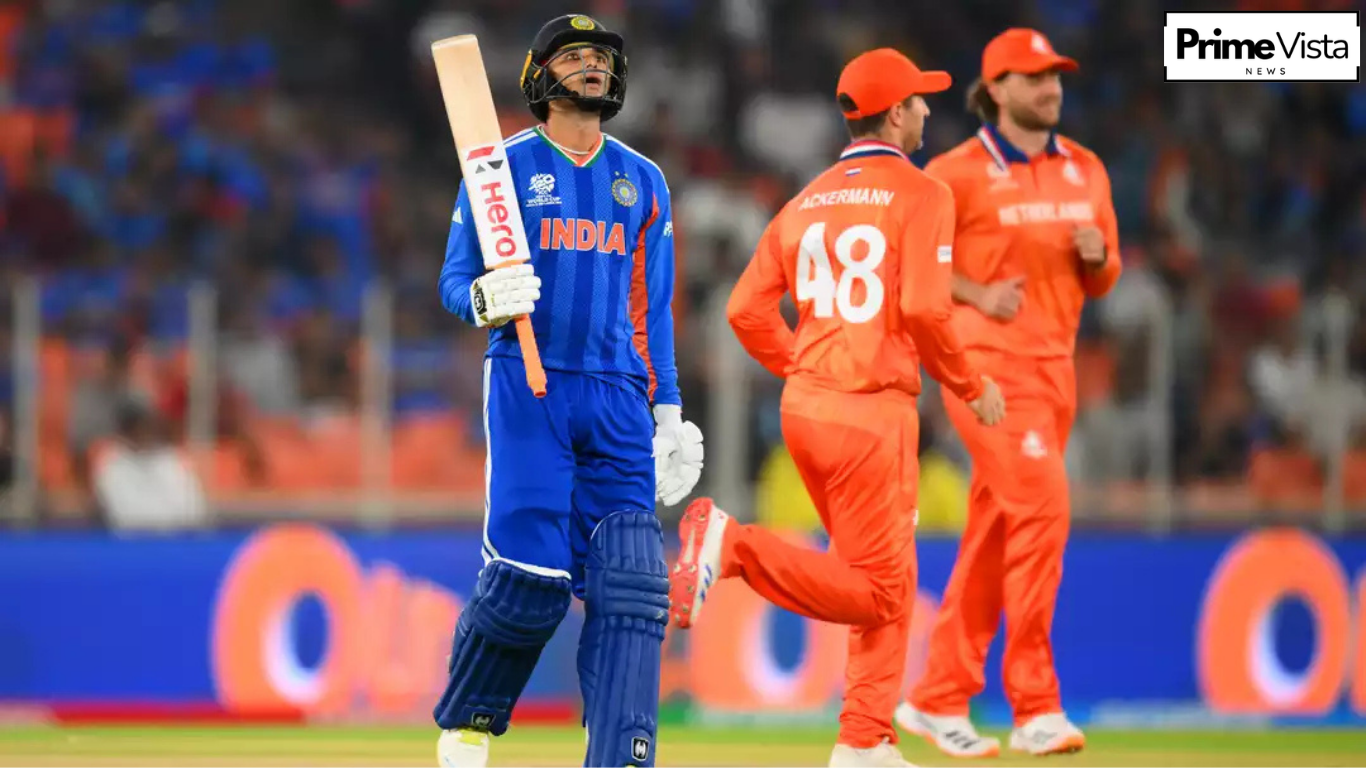
The world No. 1 T20I batter was dismissed for a duck for the third consecutive match during India’s Group A clash against the Netherlands at the Narendra Modi Stadium. The three-ball dismissal marked his third straight score of zero in the ongoing ICC Men’s T20 World Cup 2026, placing him alongside Sanju Samson for the most ducks by an Indian batter in a single T20I calendar year.
Sharma, who had also fallen without scoring against the USA and Pakistan earlier in the tournament, is yet to open his account in this World Cup. On Wednesday, Netherlands off-spinner Aryan Dutt struck in the opening over, beating the left-hander’s defence as the ball rattled the stumps.
A Rare Slump for a Top-Ranked Batter
For a player ranked at the top of the T20I batting charts, the sequence is striking. With Wednesday’s dismissal, Sharma now has five ducks in T20 Internationals in the 2026 calendar year. That equals Samson’s tally from 2024 the previous highest by an Indian in a single year.
In the broader international context, Pakistan opener Saim Ayub holds the record with six ducks in 2025. Sharma’s five ducks as an opener also place him alongside Chaloemwong Chatphaisan (Thailand, 2024), Kushal Bhurtel (Nepal, 2024), Dharma Kesuma (Indonesia, 2025) and Parvez Hossain Emon (Bangladesh, 2025) among players with the second-most ducks in a calendar year.
For India, however, the immediate concern is less about records and more about form at the top of the order as the knockout stages approach.
India Recover After Early Blows
Despite the early setback, India steadied themselves to post a competitive 193 for 6 in their final group-stage fixture.
Captain Suryakumar Yadav won the toss and elected to bat, but the innings began shakily. Sharma’s dismissal in the first over was followed by another blow when Dutt removed Ishan Kishan for 18, the ball deflecting onto the stumps. India ended the powerplay at 51 for 2.
The Netherlands maintained pressure when veteran all-rounder Roelf van der Merwe produced a sharp diving catch at long-off to dismiss Tilak Varma for 31, reducing India to 74 for 3 at the halfway mark.
Earlier Coverage : Punjab Defends MP Amritpal Singh’s Detention, Cites Hit List and Terror Links in High Court
Shivam Dube Turns the Momentum
The momentum shifted decisively through Shivam Dube, who delivered a counterattacking innings under pressure. Dube reached his maiden T20 World Cup half-century in just 25 balls and eventually made 66 off 31 deliveries, striking four fours and six sixes.
He added 76 runs for the fifth wicket with Hardik Pandya, accelerating sharply in the middle overs. A 19-run 13th over signalled India’s intent, as Dube cleared the ropes twice and pierced the infield with authority.
Although Yadav departed for 34 after briefly threatening to dominate, Dube continued to attack, ensuring India added 75 runs in the final five overs to push the total beyond 190.
For the Netherlands, Logan van Beek stood out with figures of 3 for 56, while Aryan Dutt (2 for 19) and Kyle Klein (1 for 38) provided support.
Balancing Team Success and Individual Form
India’s strong total underlined the depth in their batting line-up, but Sharma’s run of ducks will remain a talking point. In T20 cricket, fortunes can change quickly, and top-order players are often judged as much on momentum as on aggregate numbers.
With the group stage nearing its conclusion, India will hope their premier opener rediscovers rhythm before the high-pressure knockout phase. For now, the team can take comfort in a collective performance that masked individual struggles even as the record books note a rare statistical blemish.