













Corruption, Case Backlog Among Key Challenges Flagged in New NCERT Class 8 Judiciary Chapter :
Prime Vista News
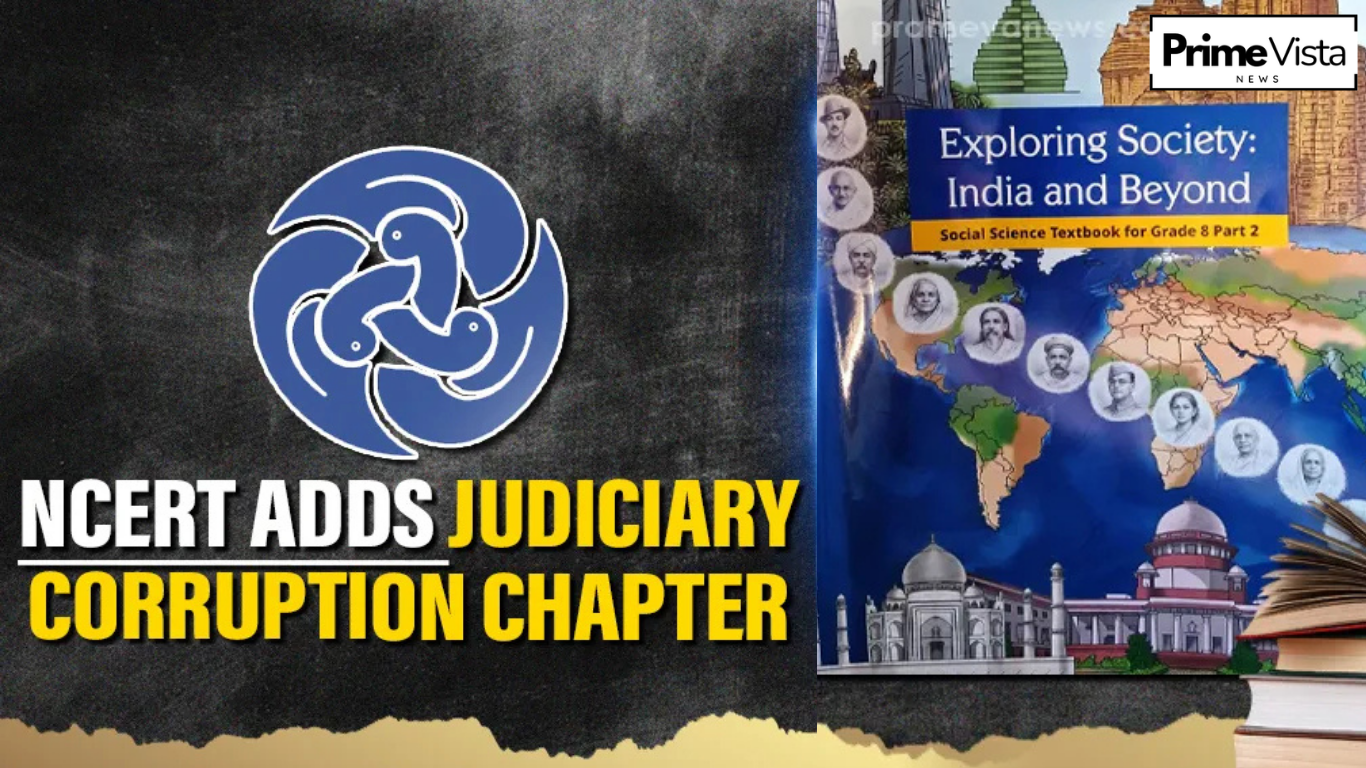
The revised NCERT Class 8 social science textbook flags corruption, case pendency and judicial vacancies as major challenges facing India’s judicial system.
NCERT Flags Systemic Challenges in India’s Judiciary
India’s judicial system faces persistent challenges ranging from corruption and an overwhelming backlog of cases to a shortage of judges, according to the revised NCERT social science textbook for Class 8.
The observations are part of a newly updated chapter that seeks to offer students a more realistic and nuanced understanding of how the judiciary functions and where it struggles beyond its constitutional role.
New Chapter Moves Beyond Court Structure
Titled “The Role of the Judiciary in Our Society,” the revised chapter marks a clear shift from earlier editions of the textbook, which largely focused on the hierarchy of courts and access to justice.
The updated content goes further by explicitly acknowledging structural and ethical challenges faced by the judicial system, presenting them as issues that affect public trust and the delivery of justice.
Textbook Addresses Corruption in Judiciary
One section of the chapter is devoted to corruption in the judiciary, noting that judges are bound by a strict code of conduct that governs not only their conduct in court but also their behaviour outside judicial proceedings.
The book states that despite such safeguards, corruption is experienced at various levels of the judiciary, particularly impacting the poor and disadvantaged.
“People do experience corruption at various levels of the judiciary. For the poor and the disadvantaged, this can worsen the issue of access to justice,” the chapter notes.
Impact on Access to Justice Highlighted
The textbook stresses that corruption disproportionately affects vulnerable sections of society, deepening existing inequalities in access to legal remedies.
It adds that sustained efforts are being made by both the Union and state governments to build public confidence in the judiciary. These efforts include increased use of technology, transparency measures, and swift action against confirmed instances of misconduct.
Case Backlog Figures Presented in Detail
The revised chapter also presents stark data on case pendency across courts, offering students a clearer picture of the scale of the problem.
According to the textbook:
- Around 81,000 cases are pending in the Supreme Court
- Nearly 62.40 lakh cases are pending across high courts
- District and subordinate courts face a backlog of approximately 4.70 crore cases
The book identifies case backlog as a major factor contributing to delays in justice delivery.
Judicial Accountability Mechanisms Explained
In an effort to balance criticism with institutional safeguards, the chapter highlights the judiciary’s internal accountability mechanisms.
It refers to the Centralised Public Grievance Redress and Monitoring System (CPGRAMS) as a formal channel through which complaints against judicial officers can be submitted and reviewed.
Over 1,600 Complaints Received Via CPGRAMS
According to the textbook, more than 1,600 complaints were received through the CPGRAMS mechanism between 2017 and 2021.
The inclusion of these figures is aimed at familiarising students with existing oversight systems and reinforcing the idea that judicial accountability, though complex, is institutionally recognised.
Former CJI’s Remarks Quoted on Public Trust
The textbook also quotes former Chief Justice of India B R Gavai, who in July 2025 acknowledged that corruption and misconduct within the judiciary have a damaging effect on public confidence.
“Instances of corruption and misconduct within the judiciary have a negative impact on public confidence,” Gavai is quoted as saying.
Earlier Coverage : Why Trump’s New 15% Tariffs Could Again Be Headed for Legal Trouble ?
Transparency and Accountability Emphasized
The former CJI further underlined that restoring trust requires firm and transparent action.
“However, the path to rebuilding this trust lies in the swift, decisive and transparent action taken to address and resolve these issues. Transparency and accountability are democratic virtues,” the textbook quotes him as saying.
Educational Shift Reflects Broader Civic Awareness
Education experts say the revised chapter reflects an effort to promote civic awareness and critical thinking among students by presenting institutions as dynamic systems with strengths and weaknesses.
By acknowledging challenges alongside constitutional ideals, the book aims to foster informed engagement rather than blind reverence.
Context & Impact
The updated NCERT Class 8 textbook represents a notable shift in how India’s judicial system is presented to young learners. By openly addressing corruption, case backlog and accountability mechanisms, it offers a more grounded and transparent picture of the judiciary.
While reaffirming the judiciary’s central role in democracy, the chapter also underscores the importance of reform, integrity and public trust lessons that extend well beyond the classroom.