











Why Trump’s New 15% Tariffs Could Again Be Headed for Legal Trouble ?
Prime Vista News
Donald Trump’s new 15% tariffs, imposed under a rarely used 1974 law after a Supreme Court setback, are facing fresh legal and economic scrutiny from experts and lawyers.
Trump Rolls Out New Tariffs After Supreme Court Setback
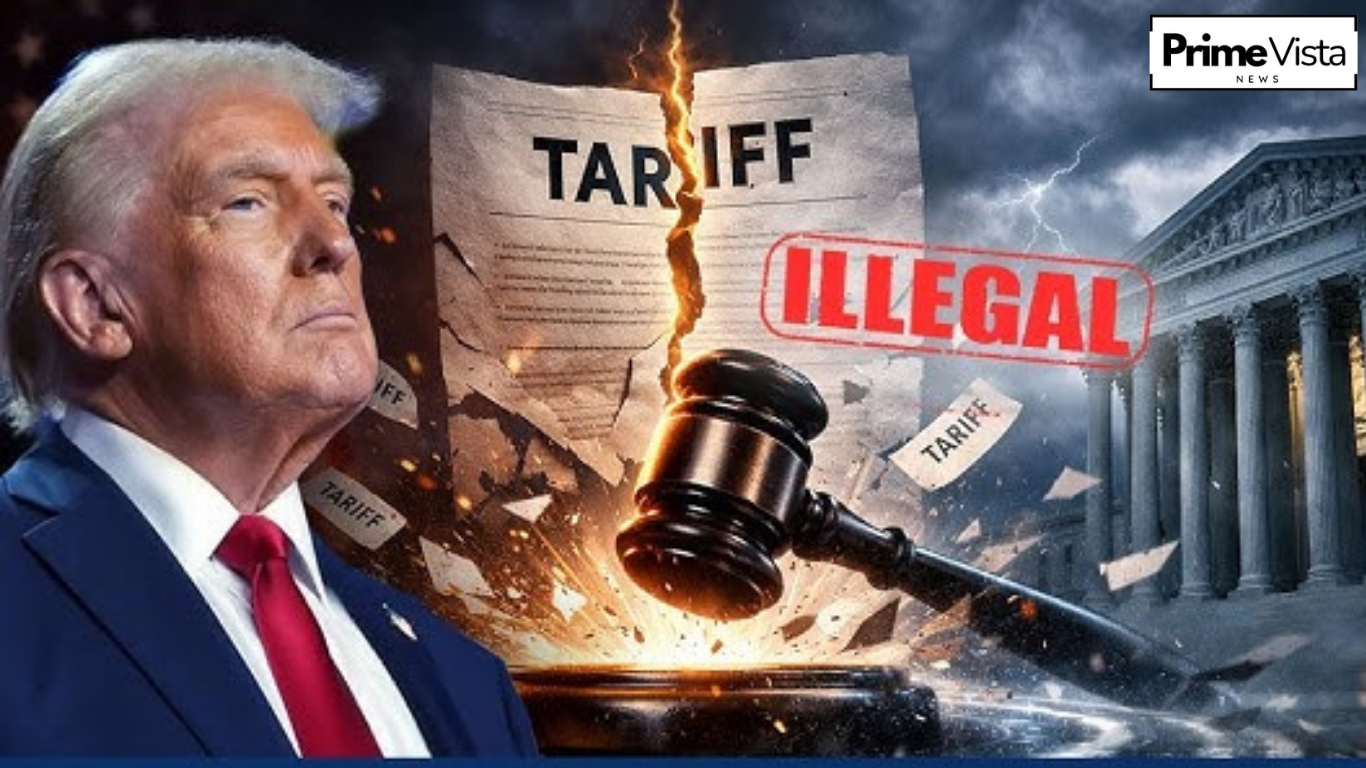
US President Donald Trump’s newly announced 15 per cent tariffs, imposed after the US Supreme Court struck down his earlier trade measures, may once again be on shaky legal ground.
The Trump administration began collecting the new tariffs at midnight on Tuesday, shortly after the Supreme Court invalidated its use of the International Emergency Economic Powers Act (IEEPA) to justify sweeping import duties. In response, the White House turned to a different statute- Section 122 of the Trade Act of 1974 a provision that has never been used before.
That shift in strategy, however, has raised fresh questions among economists and legal experts about whether the tariffs can withstand judicial scrutiny.
What Is Section 122 and Why It Matters
Section 122 allows a US president to impose temporary duties of up to 15 per cent for a maximum of 150 days on imports from any country. The authority is limited to situations involving a “large and serious” balance-of-payments deficit or a “fundamental international payments problem.”
In its tariff order, the Trump administration argued that such conditions exist, citing a $1.2 trillion annual US goods trade deficit, a current account deficit of 4 per cent of GDP, and a reversal of the US primary income surplus.
The administration framed these indicators as evidence of a serious balance-of-payments issue requiring urgent action.
Economists Push Back on White House’s Claims
Economists have strongly disputed that assessment. Gita Gopinath, former First Deputy Managing Director of the International Monetary Fund, rejected the administration’s characterization of the US economic situation.
“We can all agree that the US is not facing a balance of payment crisis,” Gopinath told Reuters, noting that such crises typically involve surging borrowing costs and a loss of access to global financial markets.
She emphasized that the US economy currently shows no signs of those stress indicators the dollar remains stable, capital continues to flow into US markets, and interest rates are not spiraling.
Trade Deficit Is Not a Balance-of-Payments Crisis
Gopinath also dismissed the White House’s claim that the US primary income balance turning negative for the first time since 1960 signals a major payments problem.
She attributed the shift to a surge in foreign investment in US equities and high-risk assets over the past decade investments that have outperformed foreign markets rather than to any systemic weakness.
“No matter how one looks at the current circumstances the condition of the US economy, its balance of payments or its currency regime none of these meets the standards outlined under Section 122,” RSM chief economist Joe Brusuelas told Axios.
Experts Say Law Targets a Different Kind of Crisis
Former US Treasury and IMF official Mark Sobel pointed out that balance-of-payments crises are typically associated with countries that maintain fixed exchange rates.
The United States, by contrast, operates under a floating exchange rate system. Sobel noted that the dollar remains steady, the 10-year Treasury yield is relatively stable, and US equity markets continue to perform well.
Josh Lipsky, chair of international economics at the Atlantic Council, added that a true balance-of-payments crisis occurs when a country cannot pay for imports or service foreign debt a situation fundamentally different from running a trade deficit.
Trump’s Own Lawyers Once Rejected Section 122
Complicating matters further is the Trump administration’s own prior legal position.
In court filings last year defending the now-invalidated IEEPA tariffs, the Justice Department explicitly dismissed Section 122 as irrelevant. Government lawyers argued that the statute had no “obvious application” to trade deficits, which they said were conceptually distinct from balance-of-payments deficits.
That earlier stance could now undermine the administration’s defense if the new tariffs are challenged.
Legal Experts See Easy Target for Litigation
Neal Katyal, who argued before the Supreme Court on behalf of plaintiffs challenging the IEEPA tariffs, said the administration’s reversal opens the door to swift legal action.
“If the president adheres to this plan of using a statute that his own Justice Department has said he can’t use, yeah, I think that’s a pretty easy thing to litigate,” Katyal told CNBC.
He added that such a challenge might not even need to reach the Supreme Court.
Earlier Report : Canada Initiates Citizenship Revocation Against 26/11 Accused Tahawwur Rana !
Who Might Challenge the New Tariffs
It remains unclear who will lead any legal challenge. Sara Albrecht, chair of the Liberty Justice Center which represented small businesses that challenged the earlier tariffs said the group is closely monitoring the new order.
“Our immediate focus is simple: making sure the refund process begins and that checks start flowing to the American businesses that paid those unconstitutional duties,” she told Reuters.
Clock May Run Out Before Courts Decide
Even if lawsuits are filed, legal experts note that courts are unlikely to issue a definitive ruling within the 150-day window allowed under Section 122.
That delay could give Trump time to pursue alternative tariff strategies using more established legal authorities, including Section 232 for national security and Section 301 for unfair trade practices.
Conclusion
Trump’s new 15 per cent tariffs may offer a temporary workaround after the Supreme Court setback, but legal and economic experts say the foundation is far from solid. By invoking a statute designed for crises the US is not experiencing and one his own lawyers previously rejected the administration may have set the stage for another high-stakes courtroom battle.
Whether the tariffs survive may ultimately depend not just on economic arguments, but on how courts interpret the limits of presidential trade authority.