













‘Community’: Why a Sikh Professional Left the US to Return Home to Punjab ?
A UCLA-educated Sikh professional explains why he left the US for Punjab, saying community and belonging matter more than money.
PRIME VISTA NEWS
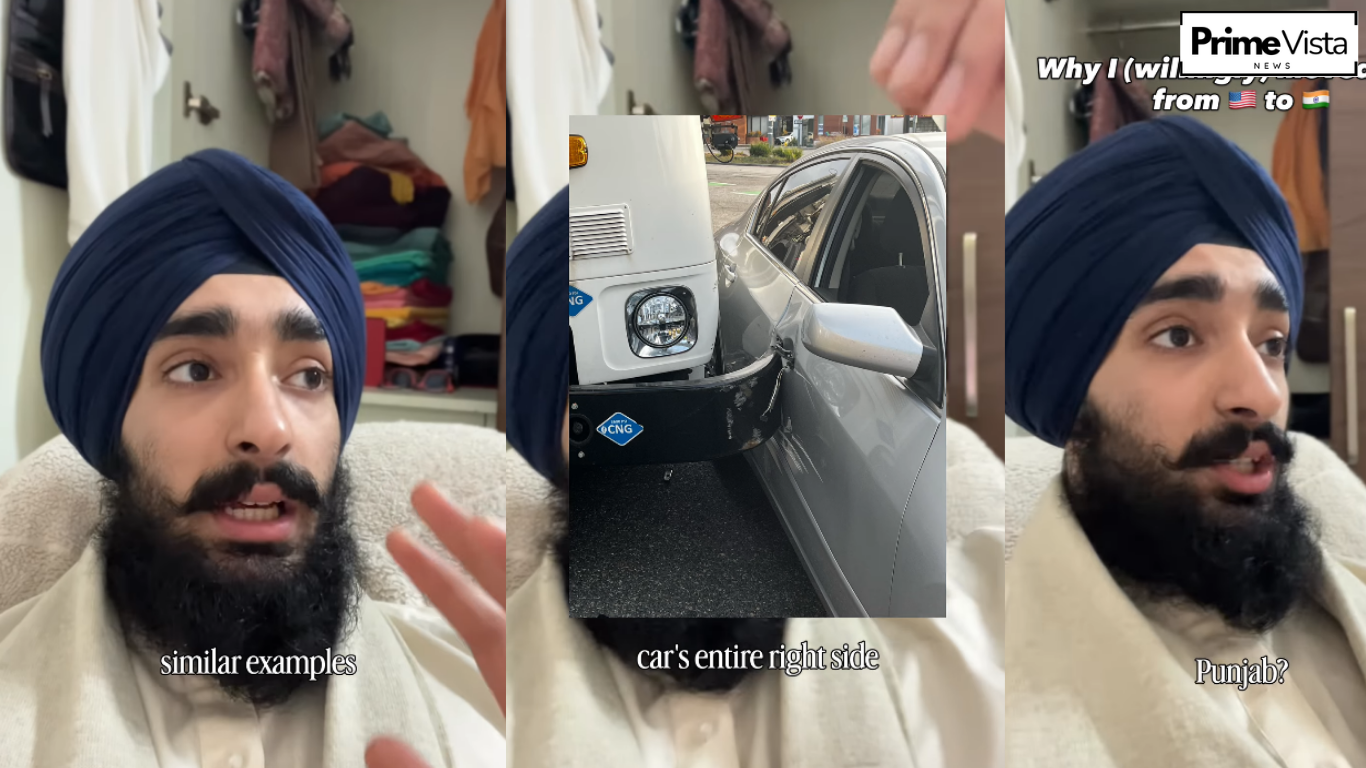
At a time when overseas migration is often equated with achievement, a Sikh professional’s decision to leave the United States and return to Punjab has ignited debate across social media. Asked to summarise his reason in a single word, Sanjum Singh Dhaliwal’s answer was direct: community.
Dhaliwal, who studied at the University of California, Los Angeles (UCLA), shared a video detailing why he chose to step away from what many describe as the “American dream” and resettle in India. His reflections have resonated widely, prompting conversations about quality of life, support systems and what truly defines success.
Beyond Opportunity and Income
California is widely viewed as a hub of opportunity, innovation and financial mobility. For many young professionals, it represents ambition fulfilled. Dhaliwal acknowledged this perception but argued that financial prospects alone cannot determine long-term fulfilment.
According to him, the decision to return to Punjab was not rooted in dissatisfaction with the US, but in a deeper reassessment of priorities. He said the sense of belonging and everyday ease he experiences in Punjab carries more weight than higher earning potential abroad.
“Living in Punjab gives me something money cannot,” he said in his video, describing his choice as value-driven rather than economic.
Two Incidents, Two Experiences
To explain his thinking, Dhaliwal recounted two personal experiences one in the United States and another in Punjab.
In the US, he said a government-operated garbage truck damaged his car. What followed, he described, was a prolonged and frustrating process. City authorities offered limited assistance, while insurance and repair estimates ran into thousands of dollars.
Eventually, Dhaliwal said he and friends repaired the vehicle themselves, spending around $250. While the issue was resolved, he characterised the experience as stressful and isolating.
In Punjab, he described a contrasting episode. When his car developed a clutch issue, he contacted a local mechanic around early afternoon. The mechanic arrived within an hour, took the vehicle for repair, returned it the same day and charged approximately $110.
For Dhaliwal, the difference extended beyond cost.
“The focus was on helping first. Money came later,” he said, emphasising what he saw as a more human approach to problem-solving.
A Debate Beyond Numbers
Dhaliwal has been clear that his decision was not based on currency conversion or comparative pricing. Instead, he framed it as a question of how societies function on a daily level how people respond to inconvenience, and how communities support individuals.
“No amount of money can replace the hospitality and support I feel here,” he wrote, reiterating that his return was about connection, not savings.
In a lighter remark, he added that “Amritsar kulche” ranked among his reasons for moving back a nod to the cultural and emotional pull of home.
Divided Reactions Online
The video quickly gained traction, with viewers offering sharply differing perspectives.
Some argued that Dhaliwal’s experience reflects lower labour costs in India rather than a fundamentally stronger sense of community. They pointed out that higher repair costs in the United States are linked to wage standards, insurance structures and regulatory systems.
Others countered that life in the US can feel transactional and isolating, particularly without extended family or long-standing social networks. For them, Dhaliwal’s story underscored the intangible value of familiarity and social cohesion.
Several commenters stressed that migration decisions are deeply personal and shaped by individual circumstances rather than universal truths.
Earlier Report: Hardik Pandya’s Valentine’s Day Surprise — Mahieka Sharma’s ‘M’ Tattoo Sparks Buzz Online
Rethinking the ‘American Dream’
Dhaliwal’s story arrives amid a broader re-evaluation among segments of the Indian diaspora about what success looks like. For decades, overseas settlement has been associated with upward mobility and prestige. Yet conversations around mental well-being, social isolation and cultural connection are becoming more prominent.
His decision does not dismiss the opportunities available abroad. Instead, it raises a more nuanced question: whether economic advancement alone defines a fulfilling life.
In migration narratives, the emphasis often falls on income, career progression and global exposure. Dhaliwal’s perspective shifts that focus toward daily lived experience the texture of routine life, the availability of support and the comfort of shared cultural understanding.
Home as a Personal Equation
Ultimately, Dhaliwal’s choice reflects a recalibration of priorities. While professional prospects may be stronger in some markets, the equation of “better” remains subjective.
For him, the determining factor was not weather, infrastructure or salary bands. It was the feeling of being embedded in a community where assistance feels instinctive rather than procedural.
As debates over migration and identity continue, his story highlights a reality often overlooked in global mobility discussions: that belonging, for some, can outweigh ambition.