














AI Will Eclipse Past Revolutions, India Positioning to Lead New Tech Era: Ashwini Vaishnaw !
Ashwini Vaishnaw says AI will power a fifth industrial revolution, with India advancing sovereign models, chip design and talent to lead globally.
PRIME VISTA NEWS
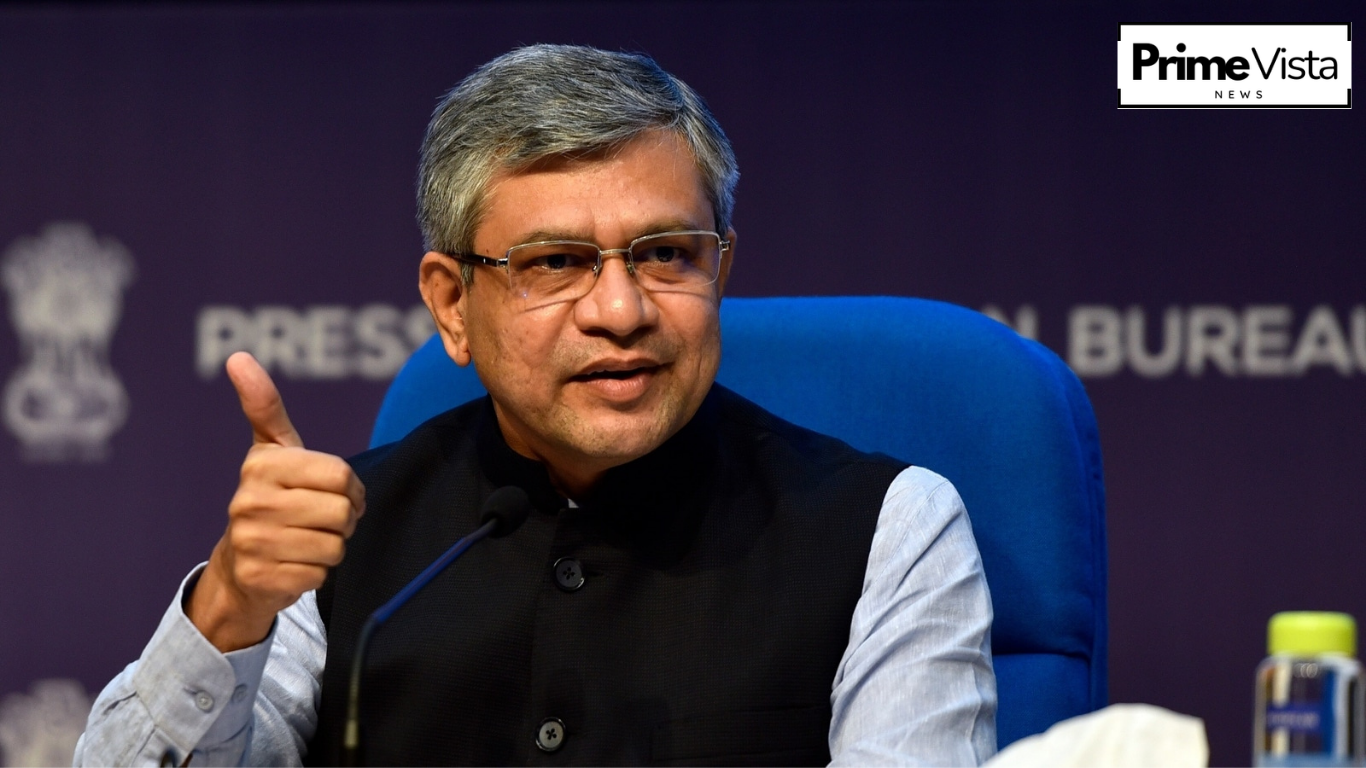
Artificial Intelligence will transform the global economy at a pace and scale surpassing every previous industrial shift, Union Minister Ashwini Vaishnaw said on Saturday, describing AI as the driving force behind what he called a “fifth industrial revolution.”
Speaking at the ET Now Global Business Summit 2026, the minister argued that AI’s impact would extend far beyond automation, reshaping governance systems, industrial production, services, and social structures simultaneously.
“The pace and scale at which AI will change economies, societies and governance systems will be unprecedented,” Vaishnaw said, underlining the urgency for nations to prepare structurally rather than react incrementally.
A Structural Shift, Not a Tech Upgrade
Unlike earlier waves of mechanisation, electrification or digitisation, AI represents a foundational shift in how decisions are made and value is created, the minister suggested. From predictive healthcare systems to automated manufacturing lines and adaptive governance tools, AI’s applications are already spreading across sectors.
Vaishnaw said India is preparing for this transition through a coordinated national strategy designed to integrate talent, infrastructure and regulatory frameworks.
He framed the moment as a turning point: countries that adapt quickly will shape the next phase of economic power, while those that lag risk technological dependence.
India’s Five-Layer AI Strategy
At the core of India’s approach is what Vaishnaw described as a five-layer AI stack. This includes talent and applications, AI models, data infrastructure, semiconductor capabilities, and governance systems.
India’s established position as a global IT services hub, he said, offers a foundation for scaling AI capabilities. Over the past two-and-a-half years, Indian IT firms have invested significantly in reskilling their workforce and building AI-driven platforms.
“Our focus has conventionally been on IT services. Now we have to convert this strength,” he noted, signalling a shift from back-end support to front-line AI innovation.
Global demand, he added, is increasingly centered on AI systems that combine advanced algorithms with deep sectoral expertise an area where Indian firms are expanding their presence.
India to Host AI Impact Summit
As part of its push to shape global AI discourse, India will host the AI Impact Summit later this year. The event follows similar summits held in the United Kingdom, South Korea and France.
Vaishnaw described it as the largest AI-focused gathering of its kind, with more than 20 Heads of State and Government and over 100 global industry leaders expected to attend.
Unlike previous technology conferences centered on product demonstrations, the summit will emphasize AI’s real-world implications. Discussions are expected to span healthcare, manufacturing, governance, education and climate resilience sectors where AI deployment is accelerating.
The event signals India’s intention to move beyond service delivery and position itself as a key architect of the global AI ecosystem.
Sovereign AI Models in Focus
A major announcement at the summit will be the launch of sovereign AI models by Prime Minister Narendra Modi, Vaishnaw said.
According to the minister, several Indian-developed models have performed strongly in benchmark evaluations, in some cases matching or surpassing leading global systems such as OpenAI and Gemini Pro.
He stressed that sovereign AI capability is essential for data security, cultural alignment and strategic autonomy. In an era where AI systems influence information flows and policy decisions, dependence on external platforms could pose long-term risks, he indicated.
“These results show that with frugal innovation and efficient use of resources, India can build world-class AI models,” Vaishnaw said.
Earlier Report: Cabinet Approves Rs 5,983-Crore Delhi–Ambala Rail Expansion to Boost Capacity and Strategic Connectivity.
Semiconductor Push Gains Momentum
AI expansion depends heavily on semiconductor strength, particularly in chip design and processing capacity. Vaishnaw pointed to advances in India’s chip design ecosystem, noting increased participation from startups, research institutions and academic centres.
While fabrication remains a longer-term objective, he expressed confidence that design capabilities are reaching maturity and will yield tangible outcomes in the near future.
Strengthening domestic semiconductor capacity, he said, is critical to reducing reliance on global supply chains and supporting sustained AI growth.
Preparing for Rapid Disruption
The minister cautioned that AI-driven transformation will be swift and far-reaching. Education systems, industries and regulatory institutions must adapt quickly to remain competitive.
Proactive skilling, adaptive governance and coordinated policymaking will be essential to harness AI’s benefits while mitigating potential risks, he added.
As global competition intensifies over who defines the rules and architecture of AI deployment, Vaishnaw outlined India’s ambition clearly: to emerge not merely as a participant, but as a leader in shaping the AI-powered future.