













After a Decade in Canada, Couple Returns to India as OCI Holders and Shares Practical Insights on Work, Taxes, and Daily Life :
Prime Vista News
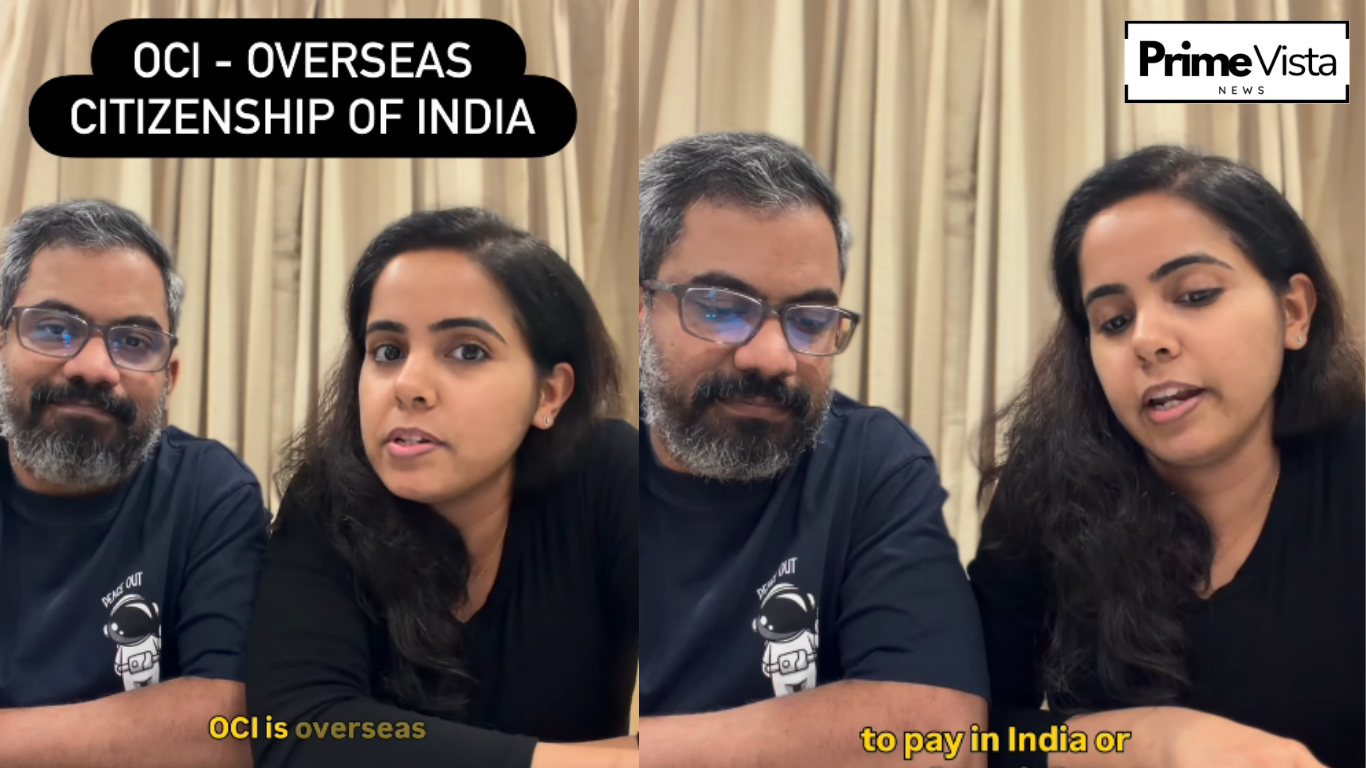
After spending nearly ten years in Canada, Sneha Khilwani and her family have relocated to India, choosing to live as Overseas Citizens of India (OCI). Through a recent social media video, the couple addressed common questions they received following their move, offering clarity on employment, taxation, property ownership, education, and long-term residency in India under OCI status.
Sneha explained that her family of four are Canadian citizens currently residing in India using their OCI cards. The video was shared in response to numerous inquiries from Indians living abroad who are considering a similar return but remain uncertain about legal and practical implications.
OCI, or Overseas Citizen of India, is a status granted to individuals of Indian origin who hold foreign citizenship. While it does not confer Indian citizenship, it provides a lifelong visa that allows holders to live and work in India without the need for periodic renewals. The status also grants access to education, healthcare, and property ownership under defined conditions.
Employment Opportunities in India
Employment is often one of the primary concerns for individuals returning to India after years abroad. According to the couple, OCI holders are legally permitted to work in India, with certain restrictions. They clarified that OCI cardholders cannot take up employment in government roles or work in journalism. However, opportunities in the private sector remain open.
The couple noted that employers generally respond positively to candidates holding foreign passports and that OCI status does not typically create barriers during the hiring process. They also shared that OCI holders are eligible for employee benefits such as the Employees’ Provident Fund (EPF), similar to other employees working in India.
Taxation Rules Explained
Taxation is another area that raises concern for families with financial ties in more than one country. Sneha explained that income is taxed in the country where it is earned. For individuals earning income in both India and Canada, the two countries have a Double Taxation Avoidance Agreement (DTAA) in place.
Under this agreement, income taxed in one country is taken into account when calculating tax liability in the other, preventing the same income from being taxed twice. The couple emphasized that OCI holders are not subject to a separate tax regime solely due to their citizenship status.
Living in India on OCI Status
OCI holders are allowed to reside in India for an unlimited period. The OCI card functions as a lifelong visa, removing the need for regular renewals or extensions. While the status itself does not expire, periodic updates such as photograph renewals are required in line with government guidelines.
The couple highlighted that this long-term residency flexibility was a significant factor in their decision to return.
Property Ownership Rules
OCI holders are permitted to purchase residential property in India, including apartments and houses. However, Sneha pointed out an important restriction that often surprises returning families: OCI holders are not allowed to purchase agricultural land.
This limitation can affect individuals who wish to invest in farmland or inherit ancestral agricultural property, and the couple advised prospective returnees to plan accordingly.
Education for Children
Education is a key consideration for families relocating to India. Sneha clarified that at the school level, most institutions charge the same fees regardless of nationality, meaning OCI students are not subject to higher tuition.
At the university level, however, fee structures may differ. Many higher education institutions charge higher fees for foreign nationals, and she advised parents to review individual university policies before applying.
Documentation and Renewals
The couple also addressed administrative concerns, noting that Canadian passports can be renewed from India. OCI documentation can be updated when required, and while the status itself remains valid indefinitely, compliance with update requirements is necessary.
According to Earlier Coverage : “I Can’t Do It for EMI and Survival”: Pankaj Tripathi Reflects on Taking a Break From Acting :
A Practical Perspective
By sharing their experience, Sneha and her family aimed to provide practical information for those considering a return to India after years abroad. Their insights reflect a growing trend among overseas Indians reassessing long-term plans and exploring the flexibility offered by OCI status.
Their experience highlights that while OCI provides significant freedoms, understanding its rules is essential for a smooth transition and long-term planning.