











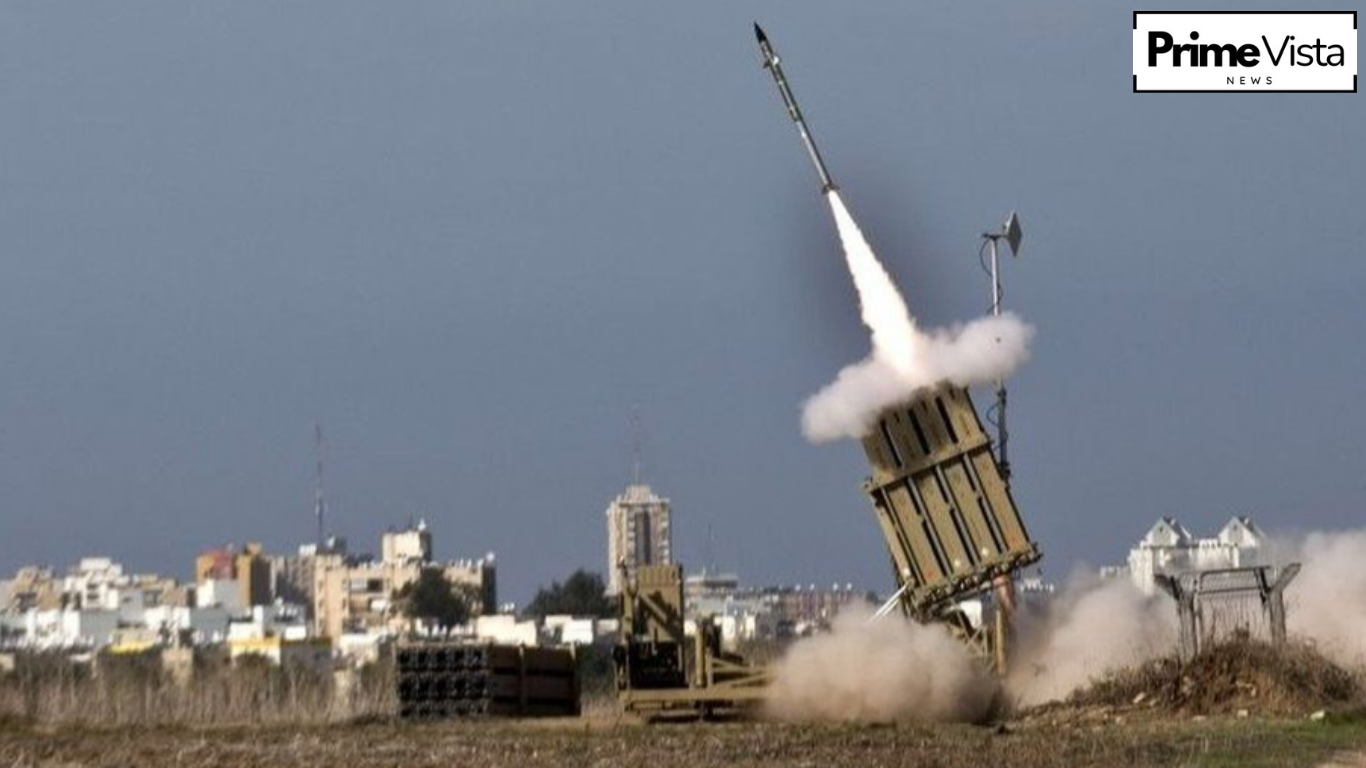
Iron Dome Under Pressure – Iranian Missile Strikes Near Israel Nuclear Site Raise Defence Concerns :
Prime Vista News
Iranian missile strikes near Israel’s Dimona nuclear facility have raised serious questions about the Iron Dome and advanced air defence systems after interception failures left nearly 200 injured.
Israel’s multi-layered air defence system, long regarded as one of the most advanced in the world, is facing renewed scrutiny after Iranian missile strikes penetrated its shield and hit areas near sensitive nuclear infrastructure.
The attacks, which struck close to Israel’s key nuclear facility in the Negev Desert, have raised urgent questions about the effectiveness of systems like the Iron Dome and the broader missile interception network jointly developed with the United States.
According to details reviewed by Prime Vista News, at least two ballistic missiles launched by Iran managed to evade interception, injuring nearly 200 people across two separate locations.
Strikes Near Sensitive Nuclear Zone Trigger Alarm
One of the most concerning aspects of the attack was its proximity to Israel’s nuclear infrastructure.
A missile struck the town of Dimona, located just around 12–13 kilometres from the country’s primary nuclear research facility in the Negev Desert. The impact left at least 78 people injured, sparking panic in what is considered one of Israel’s most heavily defended regions.
Just hours later, another missile hit Arad, a nearby town with a large ultra-Orthodox Jewish population, injuring approximately 115 people.
The scale and proximity of these strikes have intensified concerns about vulnerabilities in Israel’s defence network, particularly around high-value strategic sites.
Israel Admits Interception Failure
In a rare acknowledgement, the Israeli military confirmed that attempts were made to intercept the incoming missiles but both efforts failed.
Preliminary findings suggest that the failure was not due to a single breakdown but rather a “chain of malfunctions.” Officials have stressed that this does not indicate a systemic collapse of the defence system, but the incident has nonetheless triggered an internal investigation by the Israel Air Force.
Military spokesperson Effie Defrin stated that the incidents in Dimona and Arad were unrelated, though both exposed critical gaps in interception during a high-alert situation.
Netanyahu Calls It a “Miracle”
Israeli Prime Minister Benjamin Netanyahu visited the affected areas and described the outcome as a “miracle,” noting that despite the scale of destruction, no fatalities were reported.
However, the Prime Minister did not provide a detailed explanation for why the country’s sophisticated air defence systems failed to neutralise the threats a silence that has drawn attention amid growing public concern.
How Israel’s Air Defence System Works
Israel’s defence network is not a single system but a multi-layered shield, designed to counter threats at varying ranges and altitudes.
Key Components:
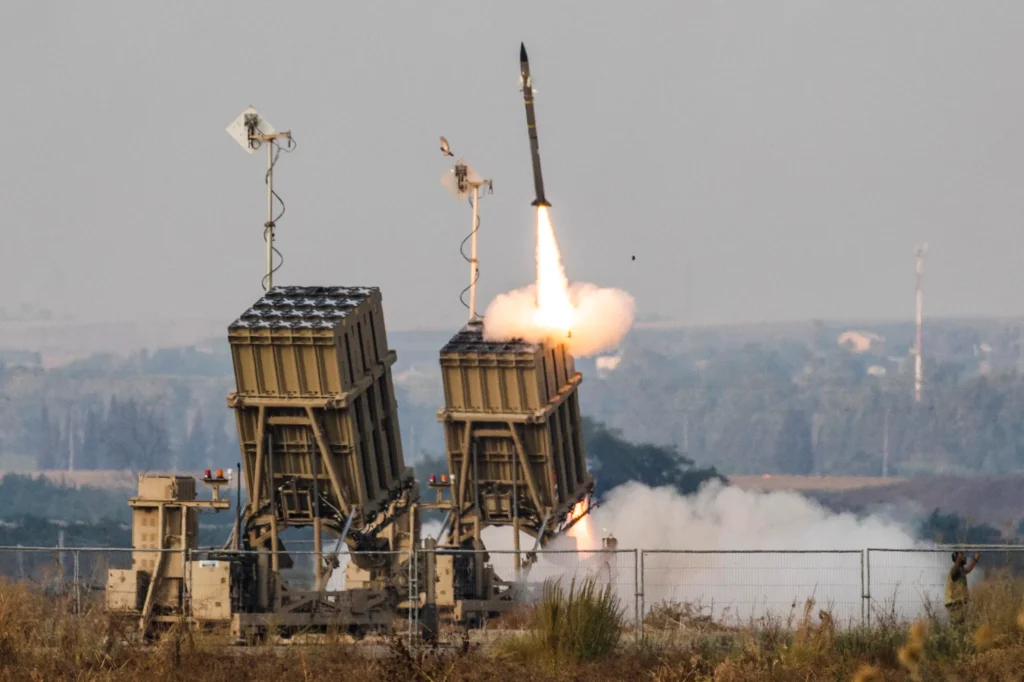
- Iron Dome
Primarily designed to intercept short-range rockets and artillery shells, often used in conflicts involving militant groups. - David’s Sling
Targets medium- to long-range rockets, cruise missiles, and drones, with an operational range of approximately 40–300 km. - Arrow 3
A high-end system developed with the United States, capable of intercepting ballistic missiles outside the Earth’s atmosphere. - THAAD (Terminal High Altitude Area Defense)
A US-supplied system reportedly deployed to strengthen Israel’s upper-tier interception capabilities.
Each layer is designed to handle a specific category of threat, creating overlapping protection. However, the recent incident suggests that coordination between these layers may have faltered.
Why Were Missiles Not Intercepted?
Initial reports indicate that the most advanced interception system, Arrow 3, may not have been deployed during the attacks. This has raised critical questions about decision-making protocols and resource allocation during active threats.
Experts point out that systems like Arrow 3 are:
- Extremely expensive
- Time-consuming to replenish
- Often used selectively to conserve inventory
As a result, lower-tier systems such as Iron Dome or David’s Sling may have been relied upon systems that are not primarily designed to intercept high-speed ballistic missiles.
Former air defence commander Ran Kochav has previously indicated that Israel is working to extend the capabilities of its lower-tier systems to handle a broader range of threats more cost-effectively.
Earlier Report : “Stop, Stop, Stop”: Final Warning Before Deadly New York Airport Collision !
Iran’s Strategic Messaging
Iran has stated that the strike near Dimona was carried out in response to an earlier Israeli attack on its nuclear facility in Natanz.
At the same time, intelligence assessments suggest that Tehran may be holding back its most advanced missile systems, possibly as part of a longer-term strategy.
This raises concerns that the recent strikes could be only a preview of more sophisticated attacks in the future.
Concerns Over Interceptor Stockpile
The incident has also revived concerns about Israel’s ability to sustain prolonged missile defence operations.
During a previous 12-day conflict, there were internal discussions within Israel’s security establishment about the risk of running low on interceptor missiles before Iran exhausted its offensive arsenal.
At the time, officials were forced to:
- Prioritise protection of densely populated areas
- Focus on critical infrastructure
- Limit use of expensive interceptors
The Israeli military has dismissed recent speculation of shortages, stating that it is fully prepared for extended conflict. However, the latest breach has reignited debate over whether existing stockpiles and strategies are sufficient.
A Critical Moment For Israel’s Defence Strategy
The latest missile strikes have exposed the complex challenges of modern air defence, where cost, timing, and technological limitations intersect.
Even the most advanced systems are not foolproof, especially when faced with evolving threats and strategic targeting.
For Israel, the incident represents more than just a technical failure it is a test of:
- Operational readiness
- Resource management
- Strategic decision-making under pressure
As investigations continue, the findings could have far-reaching implications not just for Israel, but for global defence strategies that rely on layered missile interception systems.